India is a great treasure for tourists who are interested in world heritage sites, enchanting mountains, Hill stations, honeymoon destinations, ancient monuments, transport, trains, culture, festivals, health care, Indian System of Medicines, medical tourism, education tourism etc.
We were thinking of a weekend getaway. As usual, we took the map out and looked at UK and HP options. The beautiful mountainside – during the summer is truly the stuff of dreams. From Delhi, there are so many options. Nainital, Rishikesh, Kasol, Shimla – all kinds of hill stations! We decided to go to Mcleod Ganj. (Secretly, I envy all those that stay in Delhi – you can literally go away every weekend and still not have to see the same place twice! *longface*)
Mcleod, over the last few years, has become an extremely popular destination. It is a suburb of Dharamshala in north western HP; and is most famous for the Tibetan population that lives here in exile. In fact, the Tibetan population in exile has its headquarters in Mcleod. Nestled in the Dhauladhar range (part of the outer Himalayas), it is also called Little Lhasa.
We stayed atNew Varuni House - It’s clean and quite a new property – overlooking the mountains. The walk down to this hotel is also nice. But wait, let’s discuss the stay later.
Mcleod is small congregation of smaller roads; that are always on the brink of going into complete chaos – especially during the weekend, when those small tempo travellers bring tourists from neighboring Lucknow or Chandigarh sometimes block the road. That’s when the otherwise quiet and peaceful Mcleod falls prey to traffic. The town has hardly 2 or 3 main roads – and most are filled with stores selling artefacts or eateries serving different varieties of momos. You get Tibetan paintings called Thangkas. You can buys some cds in the market with beautiful Tibetan hymns of ‘om mani padme hum’. Basically, if you’re the kind who like to splurge on every trip and carry home special souvenirs, this is your hill station.
Our first tourist place was the very famous ‘Dalai Lama temple‘ – which was fortunately a 10 minute walk from New Varuni House. When I used to think of Tibetan temples, I used to think of mountains, monks, silence, Tibetans walking around quietly in red and yellow robes, chanting etc (Some far eastern movies did influence me). The Dalai Lama temple is not far from what I used to think. In fact, you could spend hours sitting on the cool floor and get lucky to have a monk sit with you and talk about his journey from Tibet. I liked the Prayer Wheels, the sound they make when you roll them resonates and echoes. It’s a great feeling, and makes me wonder how
many souls have prayed or wished here. The prayer wheel is said to add the good karma in your life, and purify the bad karma in your life.
Outside the Dalai Lama Temple, (bang outside the gate) – is the ‘momo lady’. She makes the most amazing spinach and cheese momos!
We walked around a bit – as I said, the whole of Mcleod is divided into 2 or 3 roads – and if you explore a bit, you will come across these small lanes – one which I found on the way to our hotel. I was ecstatic – like I have found the secret place where all monks go.
We also visited the Bhagsu falls and sunset point (vista points). Bhagsu falls is great to look at – again, since I had gone on a weekend, it was crowded, and sadly, very littered. But what we did was, we found our own spot – with a great view – and occasionally would go and dip our legs in the freezing water of the waterfall.
The vista point ( I think it was Naddi ) near the sunset point is breath taking – snow clad mountains looking at you majestically. We walked a little farther down the road – to get better views. We sat by the road for a while, admiring how beautiful the Dhauladhars were, and then realized that we ought to visit Nepal to the see the Himalayas. Before sunset, we went to the other side to see the magnificent colours of dusk. From clear blue skies, to yellow – orange – pink – the sky kept changing its colour, as though it knew it had a spectator watching it eagerly. There was a small stall selling maggi and chai where all the tourists had gathered to watch this beautiful spectacle.
On the way back, we saw the Dal lake. We walked around the lake – it was quite eerie after the sunset. We had hired one of the many cabs that are easily available.
Now back to our stay. The hotel we had picked served the best aloo parathas for breakfast. It was clean – and the view was nice – On retrospect, I realize there possibly can’t be a bad view in McLeod.
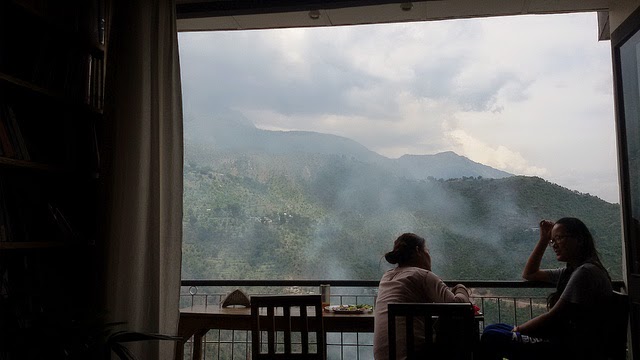
A personal highlight for me on this trip was ‘Illetarati’ – a library and a café in the middle of nowhere – which also boasts of amazing views. A friend who’s living in McLeod suggested this place. I will be grateful to him for this. The walls are completely lined with books and more books. There is a friendly dog there too – an added plus if you’re a dog lover. Sit on of one of the balconies, enjoy the view, drink a coffee, read a book, play the piano or the guitar – basically unwind. Precisely why you ran away from Delhi in the first place.
Tips:
Go on a weekday, else the small town gets very crowded with so many people that you have no place to walk
Our hotel was quite nice – recommend it to anyone going to McLeod. We booked via Makemytrip.com – the hotel room costs us around 1200 per room.
If you want to see all that there is, I strongly recommend two places where my sister and I missed. St Johns Church and Narbulingka Institute. I believe they’re must see places.
Don’t miss the momos from the momo lady
If you’re visiting Illetarati, remember it’s a quiet place, not a loud place – so if you want some quiet time, Illetarati is perfect!
We went by bus – it’s a comfortable overnight journey – you wake up in the lap of snowy mountains. We booked via Redbus.in – Round trip per person comes to approx 2500.
The total trip cost us around 5k. ( excluding the shopping of course )
Every day of our lives, we are the unwitting recipients of countless messages designed to foster discontentment. They’re very effective at making us believe we need something more. In fact, according to one study, more than 60 percent of usalways have something in mind that we look forward to buying. That’s what makes the following words seem so out of synch with our daily experience.
But godliness with contentment is great gain. For we brought nothing into the world, and we can take nothing out of it. But if we have food and clothing, we will be content with that. – 1 Timothy 6:6-8
What? Content with only food and clothing? Why, that’s downright un-American! Or so it seems. But do you know what else it is? It’s liberating.
Driving Contentment
Several years ago, my wife and I decided to give away one of our cars. It needed a cost prohibitive repair, so we gave it to a ministry that fixes cars and then gives them to needy families.
The car had 165,000 miles on it and a number of dents. It had been hit a couple of times while parked in our former neighborhood in Chicago. A tree branch even fell on it once, denting the roof. Because of its high mileage, we never bothered to fix the dents. When I was working in corporate America, I would drive into the parking lot of my office building and pass lots of new cars.
Driving that old car gave me frequent opportunities to practice contentment, and there were definitely days when I needed extra practice! What helped the most was reminding myself that having a paid-off car gave us the financial freedom to build savings targeted toward being able to leave my corporate job one day to write the book I felt called to write.
The more I dwelled on that benefit, the more thankful I felt. In the process, I saw firsthand that gratitude drives contentment and serves as a powerful antidote to our culture’s constant encouragement to want something more.
Instead of always having something in mind that we look forward to buying, what if we always had something in mind that we were thankful for? What are you thankful for? If you really want to challenge yourself, think of something you own that you’re eager to replace. Try to find something about that to be thankful for. Anything come to mind?
India’s bazaars have a type of magic associated with them. They induce an irresistible urge to own all the things you see around. The bazaars have a mind-blowing assortment of items that will force you to become a shopaholic. Apart from supporting the existence of Indians by selling essential commodities, these bazaars are essential parts of our civilization. There is a sense of delight in the chaos, crowd and cacophony existing in these markets. Usual Indian markets can be found in every corner and alley of this vast nation. But there are some markets that are very unique and we present such a list for your reading today.
Ima Keithel, Manipur: Meaning “mother’s market”, it is world’s largest “All Women Market”. More than 5,000 women shopkeepers can be found in this market. This 150 year old market is the biggest market and the lifeline of the state. Apart from fresh vegetables, fruits and other essential commodities, Ima Keithel is well known for its curio shops and specialty Northeast clothing shops. The market is situated in the heart of Manipur’s capital city, Imphal.
Jonbeel Market, Assam: This is surely “rarest of rare markets” where the Barter System is still alive! The market is available for only three days, during the Magh Bihu weekend at Dayang Belguri, Joonbeel (near Jagiroad in Morigaon district). The rarity of this fair lies in its dealings – your usual currency will not work here. Trading at this market works on the ancient Barter System. Various nearby tribes such as Tiwa, Karbi and Khasi come down from the hills to visit the fair and they bring along with them stocks of grains, livestock, fish, etc. When you buy something you have to give an equivalent amount of stocks you have brought. Started in 15th century, to bring unity among various tribes of the region, this fair is going great guns till date.
Floating Market, Kashmir: It is one of a kind floating market in India and second of its kind in the world. The only other floating market in the world is along the backwaters of the Mekong Delta in Vietnam. Floating Market on the famous Dal Lake is at least two centuries old, but gained international attention in 1960, when a Japanese photographer featured it in a tourist guide. If you want freshest vegetables in India, then this is the destination. It is learned from the locals, that the fruits and vegetables sold in the Shikaras are cultivated on the banks of the Dal Lake and cultivated no more than 2 hours before market sales time. The operation hours for the market are between 5-7 AM every day.
Attar Market, Uttar Pradesh: If Kannauj is known as the Scent Capital of India, it owes largely to this market. For the alleyways of Kannauj market teems with fragrance of finest attars. Scented oils, rose water, incense and highest quality attar are the specialities of this market. There are more than 650 perfumeries housed in this market. There are attars and scents for particular seasons available at this fragrant market. Kannauj and its market have been known for its perfumes and attars since the time of Harshavardhan, making them oldest attar market in India and probably in Asia.
Sonepur Cattle Market, Bihar: It is the largest cattle market in Asia and the market starts during Kartik Poornima (in the month of November) on the banks of Ganges. It is a one month long market-cum-fair. The origin of this market has been traced to ancient times, and it is learned that even Chandragupta Maurya used to buy elephants and horses from the market. Animals such as: all breeds of dogs, buffaloes, donkeys, ponies, Persian horses, rabbits, elephants, goats, birds and occasionally camel can be bought at the Sonepur market.
Travelling and Photography is a perfect blend for an amazing vacation. Each time we travel to a destination it is very important to capture the moment and treasure it for a lifetime. Blend your flair for photography and craving for travel with some simple tips and capture each moment of your beautiful journeys. Don’t worry if you don’t carry a high definition camera, your Smartphone camera can also do miracles if you follow the right tricks. Follow these Do’s and treasure loads of memories with some outstanding photographs.
Be ready for the right moment: Keep your mobile camera on the home screen because a good moment is always easy to lose. It may be an obvious reason to say that your phone doesn’t have charge or it’s kept somewhere in the bag, keep your power-bank handy and keep a check on your phone’s battery. Never lose a good opportunity to capture some great photographs.
Click, Click and Click: Don’t think twice while clicking a picture, take pictures of whatever you want , as many as you want. If you think you can create beauty even out of ruins just go for it. For instance: Your train is passing through Thar dessert, you can always capture the beautiful moment of sunrise or sunset. Some moments will be repeated. If you don’t like the pictures you can always delete it, but if you have lost the moment you wouldn’t get it back.
Download Photo editing apps: Add beauty to your photographs with some edits, special effects and touches. Be selective and edit only those photographs which you feel to be the best. There are various apps like Photoshop, Snapseed, LINE camera, Camera 360, Retrica which is examples of popular apps to help you create magic in your clicks. Uses these apps and create your own creativity and individual approach to editing them.
Choose unique angles: Try different perceptive and add interesting twists to your click. Take the turn and apply different angles/frames to your photographs. Develop your own unique style and don’t stop shooting. Break the monotony and try the different genre and colour filters to add life to your photographs.
Add extra lenses to your Smartphone: Smartphone cameras can click amazing photographs but adding an extra lens on your Smartphone can create wonders. How do these lenses help in better photography? Well, they are just like spectacles for your Smartphone. They assist in creating better visibility and making what’s on your screen feel more like what you see with your own eye.
Make your Pictures come alive: Print your pictures, Hang them on the wall, share it with your friends and let everybody know of your photography skills and let them get astonished of your picture clicked by a smart-phone camera.
Blood pressure rises with each heartbeat and falls as your heart relaxes. The normal blood pressure should be less than 120/80 mm hg. An increase or decrease on either end can cause various problems.
Here are some of the natural ways to control your blood pressure.
1. Having a diet low in sodium
In the event of a high blood pressure, curtail the consumption of foods that are rich in sodium. However, research reveals that sometimes it is not just enough to cut down on sodium in your diet. A person suffering from high bp should consume foods rich in minerals like calcium, magnesium and potassium as well to keep his/her bp in check.
2. Drink plenty of water and curtail the consumption of alcohol
In case a person suffers from low blood pressure, it is advisable to drink plenty of water as low blood pressure is usually accompanied by bouts of dehydration, and consumption of water can help increase your blood pressure. Also, health drinks, which are rich in electrolytes, help your raise blood pressure. But one should avoid drinks that are high in sugar, and abating your alcohol consumption also helps to quite an extent.
3. Burn extra calories and exercise regularly
Blood pressure usually increases with weight. Being overweight can lead to sleep apnea, which is marked by disruptive breathing while you sleep, which in turn condition can lead to increased blood pressure. Studies have found that weight loss is one of the most effective ways to control high bp. Regular physical activity is also advised to maintain a stable blood pressure.
4. Avoid long, hot showers
The hot water in showers and spas can expand your blood vessels, which can often lead to a drop in blood pressure. A common sign of this would be dizziness and fainting while taking a bath. Therefore, for people suffering from this condition, using warm water rather than hot water is advisable.
5. Completely avoid stress
One of the contributing factors of high blood pressure is chronic stress. Stress tends to affect blood pressure in indirect ways. Many react to stress by overeating, consumption of alcohol and smoking, all of which can increase your blood pressure. Try to know what triggers your stress and take steps to avoid it.
Why do so many people insist on having the right to mutilate a defenseless boy’s penis?
Most people refer to the removal of the foreskin from the penis as “circumcision”. When done to a non-consenting and defenceless child, there are so many disturbing issues involved that it’s difficult to know where to begin.
First of all, let’s get this straight. It is nothing short of mutilation – it is the destruction and removal of normal and healthy tissue. In fact, it’s more than just ’tissue’. It’s an extremely nerve-rich and erogenous part of the penis.
Therefore, mutilating or surgically altering someone else with no genuine medical reason is a violation of their most basic human right.
Genital mutilation has been recognized and made illegal by numerous countries and under international law – but only for girls.
Many people will say that genital mutilation of girls is much more damaging and will even be offended that male circumcision should be called “mutilation”.
It’s true that the majority of physical consequences of genital mutilation to girls is more severe (but not always!). Does that mean that boys don’t deserve any protection? If you do an internet search for “foreskin restoration” you will see thousands of sites offering men anything from counselling and support for their sense of loss or trauma through to actual ways to ‘restore’ their foreskins (such as through stretching or surgery). ‘Restoration’ is only cosmetic – true restoration is not possible.
Circumcision is permanent, irreversible, reduces sensitivity and will definately alter the way that person will experience sex for the rest of his life.
It’s clear that circumcision is male genital mutilation, an assault on a male’s body and dignity, and nothing has been done about it by the legal system. In fact, it seems as though the legal system has gone to great lengths to enusre that the practice can continue (on boys only).
Some people will try to excuse it as a part of family tradition or religious custom. That’s an odd argument because international law against female genital mutilation specifically excludes anyjustification for the practise (including religious reasons).
The arguments that male circumcision are for health reasons are ridiculous and pro-circumcision campaigners will typically use fear tactics, “what if’s” and point to theories, flawed research and so-called statistics to justify their position.
The reality is that boys who grow up in countries that do not circumcise grow up happy and healthy without the aledged health problems that pro-circumcision advocates would have you believe. For example, Sweden does not circumcise yet has less problems with AIDS and other sexually transmitted diseases than the USA which does circumcise.
In fact, a common justification used for circucisicion is that it claims to reduce urinary tract infections in boys. Did you know that girls have more problems with urinary tract infections than circumcised boys? Yet, urinary tract infection in girls is never mentioned or considered a problem. Why is that?
It’s great that girls at least have legal protection against circumcision – but why are boys specifically excluded? It’s argued that this is even illegal under U.S. law by violating the Equal Protection Clause of the Fourteenth Amendment to the U.S. Constitution.
For more details on a current legal campaign in the US against Male genital Mutilation please visitwww.mgmbill.org .
Online Petition Against Female Genital Mutilation in India
As the world celebrated International Women’s Day on March 8, some brave hearts in India launched a campaign to eliminate female genital mutilation (FGM), which has shocked and traumatized many girls and women over decades. These brave hearts belong to a group of 17 women, who started an online petition in December 2015, seeking a ban on FGM in the country. The petition was addressed to Maneka Gandhi, Union Minister for Women and Child Development, D.V. Sadananda Gowda, Minister of Law and Justice and J.P. Nadda, Minister of Health and Family Welfare.
FGM or female circumcision, which continues to be practiced by certain sections of today’s society, especially the Dawoodi Bohra community, involves traditional circumcisers either partially or completely cutting off the external genitalia of young girls.
The petition by Speak Out on FGM was launched by Masooma Ranalvi, who not only belongs to the Dawoodi Bohra community but also had to endure FGM at the tender age of seven.
“At the age of seven, I was subjected to Female Genital Mutilation (FGM) in Mumbai, in a most unhygienic and clandestine manner. The shock and trauma of that day are still with me,” she wrote in the petition that was posted on change.org. “Like me, there are thousands of my Dawoodi Bohra sisters who have been subjected to genital cutting as children, and even today thousands of Bohra girls are being subjected to this practice, since it has been ordained by the clergy of our community.”
Ranalvi explained that the apparent reason for this tradition to still exist is a long-prevailing patriarchal need to curb the sexual drive of women and exercise control over them. She clarified that the heinous practice has little to do with religion, as it is mostly a cultural tradition. Other petitioners elaborated that the cutting of female genital tissue without any medical supervision or anesthesia often results in shock, pain, excessive bleeding, genital sores and tetanus.
“It also has long-lasting psychological impact on the victims, ranging from sexual disorders, fear of sexual intimacy, nightmares and post-traumatic stress disorder,” reads the petition.
According to a report by the United Nations Children’s Fund (UNICEF), at least 200 million women and girls living across 30 nations have experienced FGM. UNICEF also listed India among the nations that continue to report instances of FGM. World Health Organization too has declared FGM a violation of human rights for women and girls.
The petitioners decided to call for the ban, realizing it causes physical as well as psychological damage in girls and women. They hope that the government's intervention by passing a law banning this heinous practice in India would make possible for anyone involved in abetting, aiding or perpetrating FGM to be punished.
The petition has received over 48,000 signatures so far and it requires another 1,688 supporters to reach its target of 50,000 votes.
Contrary to the common notion that FGM is carried out in faraway and primitive places like Africa, the truth is the heinous practice is not just conducted within tribal societies, as a growing number of girls continue to be disfigured at a young age in developing nations like India. Mumbai for instance, abounds with untrained midwives who assist in scarring young girls from the Bohra community, a sect of Shia Islam.
Despite the subject of FGM, or khatna, as Bohras typically call it, having been kept a secret for many years, this group of women are now speaking out to educate people and spread awareness within the community.
Masooma Ranalvi, a publisher in Delhi who offered her support to the online petition banning FGM, decided it was high time that she came out in the open.
She said that her pain only served as a trigger while her aim to protect other girls translated into a fearless passion. Ranalvi was cut as long as 42 years ago but she could still recall the experience as vividly as the day it took place.
“My mum told me come, I’ll take you out and buy you chocolates. I happily went with her. She took me to Bohri mohalla (in Mumbai), a cluster where 90% Bohras live. We went into this dark decrepit building. I remember being taken into a room. The curtains were drawn. She said lie down. Like an obedient child, I lay. My grandmother was holding my hands. An oldish woman pulled down my pants. … I started crying. Grandmom said don’t worry, it will be over in a jiffy. I shrieked in pain. … I experienced a sharp, shooting pain and she put some black powder there. … I came home and cried and cried and cried.”
For years after that, Ranalvi could not comprehend what she had experienced and why. When she eventually learned about FGM, she was left feeling betrayed and shattered.
Aarefa Johari, a journalist by profession, is another petitioner. Like most women in the two million-strong Bohra community, Johari too underwent FGM at a young age, without any discussion or consent.
The answer to all her questions was, “Tradition is not easy to slay. Slaying young girls is easier.”
Ranalvi and Johari were both subjected to FGM because their mothers were apparently pressured to take their daughters to Bhindi Bazaar in Mumbai by older women in the family, typically mothers-in-law and aunts. The idea that the clitoral head is a “source of sin”, “unwanted skin” or can “make women stray” outside their marriages are among the most common reasons cited to justify this cruel practice, which as a matter of fact predates Islam but continues to thrive among Bohras. Speaking to Atheist Republic, one woman even referred to the clitoral head as “haraam ki boti” (immoral lump of flesh). The saddest aspect of this painful procedure is the fact that it is carried out on young girls by older women who have experienced similar plight. Even though most women initially blame their mothers for subjecting them to this kind of brutality, they seemed to empathize with them upon growing up and realizing that they too were made to endure the same.
“There was pain and I cried. I was aware that there is a thing called khatna and the main intention is to curb sexual desire. … The first target of my anger was my mother,” said Johari.
Johari has had lengthy conversations with her mother about FGM and today the two of them campaign against the practice in unison.
“When I got it done for my daughter, I did it because it was a custom to be followed,’’ said Johari’s mother Sophie, who read an article about FGM years later. “It struck me that I should have thought about it more. I’m a science student. I really should have thought about it.”
Unlike Johari, 45-year-old Zehra Patwa, an American-based technology project manager, discovered only recently that her genitals had been tampered with when she was just a young girl. She coped with her childhood trauma by simply blocking out the memory, which according to psychologists is a common defense mechanism among those that undergo FGM.
Last year, she struggled to answer questions that were plaguing her mind through her growing years.
“I wasn’t aware this is happening in my community. A year ago, someone from my family spoke about it publicly. Lack of understanding of why it’s done bothers me the most. It goes against everything I know about my community which is educated, progressive, modern,’’ she said. “There is no openness about it. We don’t know what was done. Was it a nick, a big cut, what was it?”
Few would be able to answer such a pertinent question as there is no medical procedure to determine such a cut. Untrained midwives typically use knives or blades to carry out the procedure that recently left a seven-year-old bleeding for an entire week.
“She had to use a sanitary pad,’’ an aunt shared on condition of anonymity.
The aunt in question, like Patwa, failed to comprehend the dichotomy between the primitive practice and an otherwise progressive community. Bohra women are believed to be well educated and widely traveled.
Shaheeda Kirtane, for instance, a researcher of public health and policy, said that she was protected by her mother, Dilshad Tavawallah, who is a family and child protection advocate based in Canada. Considering her luck that allowed her to escape being put under the knife, Kirtane decided to join the fight against FGM in an attempt to stop her community from betraying its daughters.
“I’m not able to explain to myself. It’s so ingrained in culture. They unquestioningly do it to be part of the community. If you openly declare you won’t do it, the backlash is considerable and many just won’t do business with you,’’ she said.
Insia Dariwala, filmmaker and child rights activists who offered her signature for the online petition, also succeeded in escaping FGM. Her mother reportedly put her foot down after Dariwala’s older sister was taken to one of Mumbai’s dark, decrepit rooms by a relative. Yet, Dariwala feels violated in different ways.
“My sister was cut after being taken away on the pretext of a movie. I’m not cut but still feel cut off from ritualistic functions, joyous occasions. But saving other children is very important. It’s a form of child abuse,” she said.
The abuse involved in FGM is known to leave women physically, sexually as well psychologically damaged. Boston-based Maria Taher, who is now pursuing a career in fighting domestic violence, deciding to do so because of her own experiences.
“Is she emotionally damaged? No. It’s something I had to come to terms with. It took a long time for me to be okay. It is something that has affected me; it’s affected the kind of work I do. I am a social worker and my work revolves around gender violence. It’s made me the kind of person that I am,” she said.
FGM has also proven to affect marriages, with couples admitting it only recently.
One woman, who wished to remain anonymous because she lives in a Bohra neighbourhood, said, “I support the fight against FGM. I don’t think I ever enjoyed sex in my marriage. I often wonder what it would have been like if I hadn’t been cut. The sad part is I will never know.”
Among other reasons, khatna seems to be a prevailing practice because the Syneda or the high priest of the Bohra community refuses to address the issue with women or the media. Even though the United Nations has declared FGM to be a human rights violation, it continues to be practiced in India, as the government is yet to pass laws banning it.
However, with the issue becoming less taboo, Nushrat Bharucha, a prominent Bohra face in Bollywood, agreed to becoming part of the campaign against FGM.
Recalling how her parents made sure that she was not mutilated, she said, “If I have a daughter, no way is she going through this.”
Dariwala and Taher are members of Sahiyo, a non-government organization, addressing community members on an “each-one reach-one” basis. Ranalvi and Johari plan on seeking a ban on the gruesome practice when their evolving petition is ready to be presented to the Ministry of Women and Child Development, Ministry of Health and Ministry of Law. To make this possible, members of Sahiyo have been assessing the results of an online survey that they conducted. Preliminary findings of that survey reveal that as many as 80 percent of 400 respondents have already undergone FGM.
Interestingly, non-Bohra women have joined the fight against FGM as well.
Priya Goswami, director of the documentary titled “A Pinch of Skin”, said, “When I saw the film on the big screen, I realised I couldn’t move away from it. It’s great that we have formed a coalition of sorts to try and end khatna.”
Tavawallah concluded that khatna is a violation of child rights, as children are not in a position to protect themselves from the procedure, at the age when they are usually subjected to it.
“Laws play a very essential role in bringing about social change. Gender reforms are slow and hard-fought, even more so when they involve ancient, archaic and cultural practices of a secretive and closed community like the Dawoodi Bohras,’’ she said.
Women from the remaining community agreed, saying the secrecy associated with FGM often bears the burden of potential deceit and betrayal as well as a grave form of abuse on the minds and bodies of young children.