Wednesday, 1 June 2016

Homoeopathic cure of muscle and joint t pain

How Homeopathy Can Cure Muscle and Joint Pain?


Joint and muscle pain arises when excess pressure is exerted on a particular joint or due to the wear and tear of a particular muscle.

 This is one area where many people face chronic pain, with symptoms such as deformity of the joints, swelling, immobility of the joints and severe joint pain.

There are a lot of topical as well as oral medicines for chronic pain within conventional medicine, but it may not always be effective for all types of patients.

Homeopathy has been known to provide effective cures for many types of muscle and joint related ailments.

Let's first look at the common causes for muscle and joint pain related problems:

- Sports related injuries
- Vehicular accidents such as a car or bike accidents
- Bad postures or habits
- Other underlying physical or medical conditions

So what are the ways in which homeopathy can cure certain conditions and alleviate pain in patients?

- Arthritis: One of the most common problems that many people report is that of arthritis and rheumatoid arthritis, which causes a lot of pain in many people. In many cases, the use of Natrum Muriaticum and Bryonia has been known to allay the pain.

- Moving and shifting joint or muscle pains: Many patients have this problem where they face joint or muscle pain but instead of it being constant in one area, it moves around the body. Pulsatilla is known to effectively reduce the symptoms in these cases.

- Tennis elbow or tendon related problems: This is a common ailment, which in many cases is caused by strenuous activities, such as sports. Rhus tox has been known to be effective in such cases.

- Muscular conditions: There are many muscle-related conditions such as fibromyalgia and fibrositis among others have also been reduced after the usage of Rhus tox.

Homeopathic medicines like Medorrhinum, Ruta, Formica Rufa, Arnica, Symphytum and a few others are useful for treating such conditions, depending upon the exact symptoms and causes.

Related Tip: Treating Constipation Effectively with Homeopathy
How Homeopathy Can Cure Muscle and Joint Pain?.


https://linksredirect.com/?pub_id=11719CL10653&url=http%3A//www.archiesonline.com/

Which kind of clothing lets your skin breathe?

Which kind of clothing lets your skin breathe?


Between a woman dressed in a satin dress and another dressed in cotton, who do you think was more comfortable?

 The lady dressed in cotton ofcourse! It isn't the length of the dress that dictates this answer but the breathability of the fabric.

Breathability can be defined as the fabric's ability to allow air and moisture to pass through it. This is determined by the composition of fibers and how tightly they are woven together.

Wearing breathable fabric helps your skin breathe by allowing sweat to evaporate rather than block skin pores.

 This also helps regulate your body's temperature. So, when you go shopping for your summer wardrobe, look out for these fabrics.
  1. Cotton: Cotton is a natural fiber hat can be found in a number of varieties. However, not all of them are breathable. For your skin to breathe, avoid cotton blends and stick to 100% cotton fabric. Seersucker and madras cotton are great for summer. Cotton clothes are ideal for dry summers as well as humid conditions.
  2. Linen: The light weight nature of linen makes it an extremely breathable fabric. This natural fiber also absorbs moisture very well.
  3. Light Silk: Silk is often termed as a winter material but light silks are ideal for any weather. Silk is highly absorbent and dries quickly thus allowing your skin to breathe. It also has natural climate regulating properties that allow it to stay cool in summers and warm in winters. Silk is also the most hypoallergenic fabric available.
  4. Chambray: Chambray is a breathable alternative to denims. While heavy weight chambray has a rugged appeal, light weight chambray can have a casual as well as dressy appeal.
On that note, here are a few fabrics to avoid
  1. Nylon: Nylon is a completely synthetic material with low absorption and a water repellant nature. Thus not only will it not allow sweat to evaporate, it will trap your sweat within your clothes. This is both uncomfortable and unhealthy.
  2. Polyester and Polyester blends: Like nylon, polyester is water repellent and thus allows perspiration to between your clothes and your skin causing the garment to stick to the body. Don't assume a polyester cotton blend to be any better as even a 40% synthetic presence can keep the fabric from absorbing sweat.
  3. Viscose or Rayon: Both these fabrics are often passed off as cotton. However they do not have the absorption or breathability nature of cotton. While it will not trap heat like nylon and polyester, rayon also repels water thus leading to a perspiration build up.
  4. Satin: Satin is produced by weaving nylon and polyester together and hence is synthetic and does not allow the skin to breathe. Also satin is thick and heavy.
Which kind of clothing lets your skin breathe?


Archies Online

Ways to Overcome Feelings of Neediness

5 Ways to overcome feelings of neediness:


Man is different from the other species in that we are social beings.

One of the main differentiators is our constant need to 'connect' with our fellow beings.

 Be it family or friends or society at large, we constantly need to be connected to our near and dear ones and want attention, affection, and assurance.

We need to respect this basic desire and appreciate that there is nothing wrong in feeling needed.

Problems arise when this feeling to be needed gets excessive. There is a significant constant demand from the needy person, especially from those who are close to them.

Some cases where neediness is demonstrated are in new relationships.

In the beginning, there is a great urge to please and therefore a greater focus on interacting with them.

There is a fear of losing attention, there is insatiable excessive demand for attention - be it pleas, accusations, or demands - so as to not feel abandoned and deserted.

Neediness is also quite evident in people with depression.

 Again, an attempt to not be abandoned by their near and dear ones.

By making a conscious effort, the neediness can be reduced, thereby making the relationships smoother and less painful to both the parties involved.

As the saying goes - 'acknowledging the problem is half the problem solved'.

 Needy people should realize or accept if told that there is an issue and make a conscious effort to work on reducing neediness.

1. Divert attention - As simple as it might sound, it is equally effective. Indulge in whatever interests you - exercise, meditation, dance, sing, etc.

 The idea is to divert attention so that the urge to feel needy and act on that instinct is reduced. This reduces the fear of being lonely and works magic.

The busier you get, the less bored you are. As they say, be alone but not lonely.

2. Clarity in communication - One of the intricacies of neediness is making unclear demands.

 Sadly, quite often, the person does not know what he wants, and so are the demands or requests which are equally unclear.

 Once you are aware that your neediness is making you do this, make an effort to clearly communicate what you actually want.

This reduces the stress on both the parties involved and leads to a happier engagement.

3. Clarity in relationships - Take a step back and see if your neediness is affecting any major relationships.

If yes, revisit and clarify. Make an attempt and reestablish the relationships.

If it is your truly near and dear ones, they will be very forthcoming and understanding.

4. Move on - In cases where your neediness has affected another person, be wise to accept their wishes and not be more 'needy' or clingy.

This acceptance will make way for a lot of healthier relationships as you learn to deal with accepting your issues.

5. Socialize - Use your hobbies to make more friends and socialize more.

Having more people to interact with reduces your need to be accepted by the same people.

 You have more people to rely on and might make more friends for keeps.

These are some simple ways to reduce neediness on others, but as mentioned, the first step is to accept and then work on ways to reduce it.

Related Tip: Are You an Extremely Dependent Individual? Here's How to Overcome it.?

Breast cancer risk rises even with light alcohol use

Alcohol increases risk of breast cancer:


A new analysis concludes that all levels of alcohol use - even light drinking - are associated with raised risk for breast cancer, with higher consumption linked to higher risk. The researchers also summarize the biological mechanism behind the link and the impact on global breast cancer incidence and deaths due to drinking.

young woman with drink of red wine
The researchers estimate that 18.8 percent of global breast cancer cases and 17.5 percent of the deaths in 2012 were among women classed as light drinkers.
The study paper, by Dr. Kevin D. Shield from the International Agency for Research on Cancer (IARC) in Lyon, France, and colleagues, is published in the journal Alcoholism: Clinical and Experimental Research.
The findings address a long-standing debate about whether light alcohol consumption is linked to raised risk of breast cancer.
The link between alcohol consumption andcancer was officially declared in 1987, when a working group of the IARC - an agency of the World Health Organization (WHO) - listed cancers of the oral cavity, pharynx, larynx, esophagus, and liver as "causally related to the consumption of alcoholic beverages."
Since then, many studies have found links between alcohol consumption and breast cancer, and another review in 2007 by the IARC added breast cancer and colorectal cancer to the former list of cancers.
The authors also note that as recently as 2014, studies have revealed convincing evidence that alcohol raises the risk of breast cancer. However, the question of whether light drinking is linked to breast cancer remains somewhat controversial.
The new study is in three parts. First, the authors review and summarize the literature on the biology of the link between alcohol use and breast cancer. Then, they examine evidence about the size of risk and how it relates to levels of alcohol consumption. Finally, they assess the global impact of such a link, with an emphasis on light alcohol consumption.

'Dose-response relationship'

The first part of the study summarizes three biological ways alcohol affects breast cancer risk: how it changes hormone levels, how the body produces cancer-causing compounds when it metabolizes alcohol, and how it blocks a key metabolic pathway known as the "one-carbon metabolism pathway."
In the second part of the study, the researchers searched for published meta-analyses of the risk relationship between alcohol consumption - including light drinking - and the risk of breast cancer. Meta-analyses are large studies that pool and analyze data from several studies.
All but two of the 15 meta-analyses that met the researchers' criteria showed a dose-response relationship between alcohol consumption and the risk of breast cancer - even at low levels of consumption. Thus, even light alcohol drinkers are at higher risk for breast cancer than non-drinkers, they found.
Finally, when they assessed the impact of these findings on the global burden of breast cancer, the team estimated that 144,000 breast cancer cases and 38,000 breast cancer deaths in 2012 were caused by alcohol use.
Moreover, in 18.8 percent of the cases and 17.5 percent of the deaths, the women were light drinkers.
The researchers got the data on global alcohol consumption from the Global Information System on Alcohol and Health (GISAH), and the data on cancer mortality came from theGLOBOCAN database.
They used a method called Population-Attributable (PAF) methodology to produce the estimates from these data sets. PAF calculates the number of cases or deaths that would not occur if the risk factor were reduced to an alternative scenario (for example, no alcohol use).
According to the WHO, the harmful use of alcohol kills 3.3 million people worldwide every year and there are 60 different diseases where alcohol features as a significant cause.
The global consumption of alcoholic drinks in 2010 was equal to 6.2 liters of pure alcohol per person aged 15 and over.

In the United States, dietary guidelines suggest if people choose to drink alcohol it should be in moderation - up to one drink per day for women and up to two drinks per day for men. Plus, they "do not recommend that individuals who do not drink alcohol start drinking for any reason."
Dr. Shield and colleagues note:
"All levels of evidence showed a risk relationship between alcohol consumption and the risk of breast cancer, even at low levels of consumption. Due to this strong relationship, and to the amount of alcohol consumed globally, the incidence of and mortality from alcohol-attributable breast cancer is large."
Courtesy: MNT

https://linksredirect.com/?pub_id=11719CL10653&url=http%3A//www.airtel.in/


Migraine may increase risk of cardiovascular disease

Migraine may increase risk of cardiovascular disease


Previous research has shown that migraine is a risk factor for stroke, although the reasons why are not understood. A recent study demonstrates that migraine might also be a risk factor for cardiovascular disease and mortality.

[Skull and migraine]
New research infers that migraine increases the risk of cardiovascular events later in life.
Migraine, characterized by a pervasive, throbbingheadache, affects an estimated 1 in 5 Americans for at least a part of their life.


Women are affected three or four times more often than men, though the reasons for this split are not understood.
Along with the headache, some migraine sufferers also experience a so-called aura that occurs just before or during an attack. This aura consists of a selection of symptoms that can include seeing flashing lights, experiencing blind spots, confusion, and a loss of balance.
Previous research has shown that migraine, especially when it occurs with an aura, is associated with an increased risk of stroke.
Although migraine is known to have a vascular component, it is not understood exactly why there is a link between migraine and stroke, but some scientists have theorized that there may also be a link between migraine and other cardiovascular events.
However, because migraines tend to peak during midlife, and cardiovascular events become more likely with advancing age, connections have been difficult to demonstrate.

Cardiovascular events and migraine

Breaking research, published in The BMJ, set out to investigate these potential links with cardiovascular events. A collaboration between scientists in Germany and the United States analyzed data from 115,541 women enrolled in the Nurses' Health Study II.
At the start of the study, the women were all free from angina and other cardiovascular illnesses. Aged 25-42, the participants' health was charted from 1989-2011.
Of the cohort, 17,531 individuals reported migraines at the start of the study. During the course of the follow-up, 1,329 experienced cardiovascular events and 223 died from cardiovascular disease.
Even after adjusting for confounding variables, the women with migraine had an increased risk of cardiovascular events, including heart attacks, angina/coronary revascularization procedures, and stroke.
The authors conclude:
"These results further add to the evidence that migraine should be considered an important risk marker for cardiovascular disease, at least in women."
Overall, the risk for cardiovascular events and stroke was 50 percent higher in women who had migraine, compared with those who did not. This effect was independent of age.
The research team, headed up by Prof. Tobias Kurth, also discovered that migraine was associated with a higher risk of cardiovascular mortality. Even once factors such as smoking, age, postmenopausal hormone therapy,hypertension, and oral contraceptive use were adjusted for, the effect was still present.

The size of cardiovascular concern

Although the study shows a clear association between migraine and cardiovascular events, caution should be used when interpreting the size of the interaction and its implications for individuals.
The research is published alongside aneditorial written by Rebecca Burch, from Harvard Medical School, MA, and Melissa Rayhill, from The State University of New York at Buffalo. They say:
"The magnitude of the risk should not be over-emphasized [as] it is small at the level of the individual patient, but still important at a population level because migraine is so prevalent."
There are some limitations to the study - for instance, the team only used data from women, although they presume the effect would remain for men. Additionally, information for vascular biomarkers and migraine-specific information, such as the presence of aura, were not available to the team.

Although the results should not be cause for alarm, the authors of the editorial agree that "it's time to add migraine to the list of early-life medical conditions that are markers for later-life cardiovascular risk."
Further studies are likely to investigate the effect in men, and whether migraine severity and the presence of aura makes any difference to the level of cardiovascular risk.
It will also be important to understand how migraine might interact with other risk factors, such as smoking and obesity. On the other side of the coin, it will be interesting to examine whether drugs that treat the symptoms of migraine might also reduce the risk of cardiovascular events later in life.
Courtesy: MNT

https://linksredirect.com/?pub_id=11719CL10653&url=http%3A//www.airtel.in/

The Lifestyle That Is Best For The Aging Brain

The Lifestyle That Is Best For The Aging Brain


Improved working
memory, reasoning, vocabulary, and episodic memory.
Older adults who have a busy lifestyle also have better cognitive function, new research reports.

The results come from one of the most comprehensive studies of how the brain changes with age: 

The Dallas Lifespan Brain Study.

Dr Sara Festini, the study’s first author, said:

“We show that people who report greater levels of daily busyness tend to have better cognition,

especially with regard to memory for recently learned information.

Living a busy lifestyle appears beneficial for mental function, although additional experimental work is needed to determine if manipulations of busyness have the same effect.”

The Dallas Lifespan Brain Study included 330 people aged between 50 and 89.

Their daily routines were recorded along with their cognitive performance.

The results showed that whatever age they were, the brains of people who were busier worked better.
Busier people had better:

  • working memory,
  • reasoning,
  • vocabulary,
  • and episodic memory (the ability to remember specific events in the past).

It’s not yet clear exactly what causes what.

For example, people with more active brains may tend to be busier people.

The researchers, though, think that being busy gives people more opportunities to learn and puts them in more new situations.

Being busy also tends to bring people into contact with others more.

Both factors may help to stimulate the brain.

Professor Denise Park, a study co-author, said:
“We were surprised at how little research there was on busyness, given that being too busy seems to be a fact of modern life for so many.”

https://linksredirect.com/?pub_id=11719CL10653&url=http%3A//www.airtel.in/

There Be Monsters Here! How to Find the Biggest Star

There Be Monsters Here! How to Find the Biggest Star

Antares and Betelgeuse may be colossal stars, but we take it to the next level of stellar monstrosity with a visit to UY Scuti, a star that makes our Sun seem no bigger than a pinpoint.
A Sense of Scale
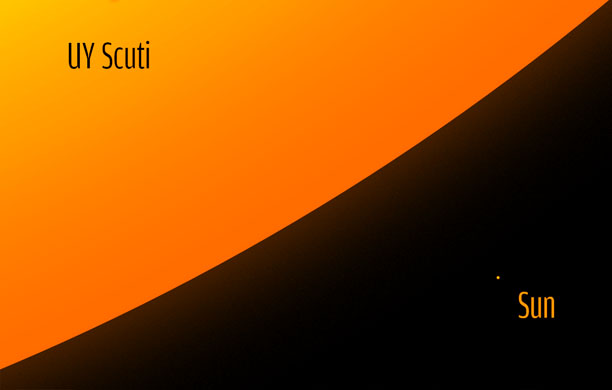
This illustration shows the approximate size of the red supergiant UY Scuti compared to the Sun.
Philip Park / CC BY-SA 3.0
Stars range in size from red supergiants that if put in place of the Sun would reach beyond Saturn down to neutron stars that would fit comfortably within a limits of small city. Great examples of bright, well-known supergiants include Orion's Betelgeuse and Antares in Scorpius. The latter twinkles a fist to the lower left of Mars this week and shares its fiery color.
At ~1,000 times the size of the Sun, Betelgeuse is an impressive star to be sure, but it's no match for UY Scuti, currently the largest star known with a diameter around 3,400 times that of the Sun. It's a crazy-bright candle, too, with a luminosity 340,000 times greater than the Sun.
If you were to replace the Sun with UY Scuti, its photospheric fringes would extend beyond the orbit of Saturn halfway to Uranus, a distance of 1.4 billion miles (2.2 billion kilometers). A beam of light would take some 7 hours to circle the star's circumference compared to 14.5 seconds for the Sun.
A selection of stellar giants, ranging from the orange giant Aldebaran up to the current size-record holder UY Scuti. Jcpag2012 / CC BY-SA 4.0
A selection of stellar giants, ranging from the orange giant Aldebaran up to the current size-record holder UY Scuti.
Jcpag2012 / CC BY-SA 4.0
You might think that such an enormous body would be easily visible with the naked eye, and it might be were it not 9,500 light-years away and squarely located in the Milky Way's Great Rift. After battling distance and dust, UY never gets brighter than magnitude +9 but can dip as low as +11.
Red Identity
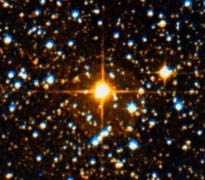
UY Scuti shines with a ruddy glow.
Haktarfone / CC BY-SA 3.0
Either way, it's still an easy catch in a 4-inch or larger telescope from reasonably dark skies. I observed it on May 22nd in a 10-inch reflector at 76× and can happily report the star hovers at the bright end of its range around magnitude +9.5. Even in full moonlight, I could detect its reddish hue.
Judging by its name, you've already guessed that UY Scuti's a variable star like so many of its supergiant brothers and sisters. Variations in the rate that the star burns helium, coupled with mass loss, cause it to undergo pulsations with a period of roughly 740 days.
UY Scuti's not difficult to find, located about 2° north of 5th-magnitude Gamma (γ) Scuti and 4° southwest of 4th-magnitude Alpha (α) Scuti just below the tail of Aquila. From the mid-United States, it climbs to 20° altitude by 11:30 p.m. local time in late May and 10:30 p.m. in mid-June.
While the map I've provided should get you right up to the star, you might also like to print out the AAVSO chart which shows the field in black-and-white reverse. Some observers find reverse maps easier to to use at the telescope.
Ruddy Giant a Flicker in Scutum
This map, which shows stars to magnitude +10, plots the position of the luminous supergiant star UY Scuti, one of the largest stars known. Click to enlarge — pardon the pun!
Stellarium
If UY Scuti whets your appetite for more monster madness, spring and summer abound with lesser though still impressive naked-eye supergiants such as Antares (750× solar), Rho Cassiopeiae (450× solar) and Alpha Herculis a.k.a. Rasalgethi (400× solar and a beautiful double star to boot). Not as well known but nearly as large as UY are V354 Cephei (1,520× solar) and RW Cephei. RW currently occupies the #3 spot in the list of largest stars with a diameter of 1,535 solar or larger than Jupiter's orbit.
Two's Company
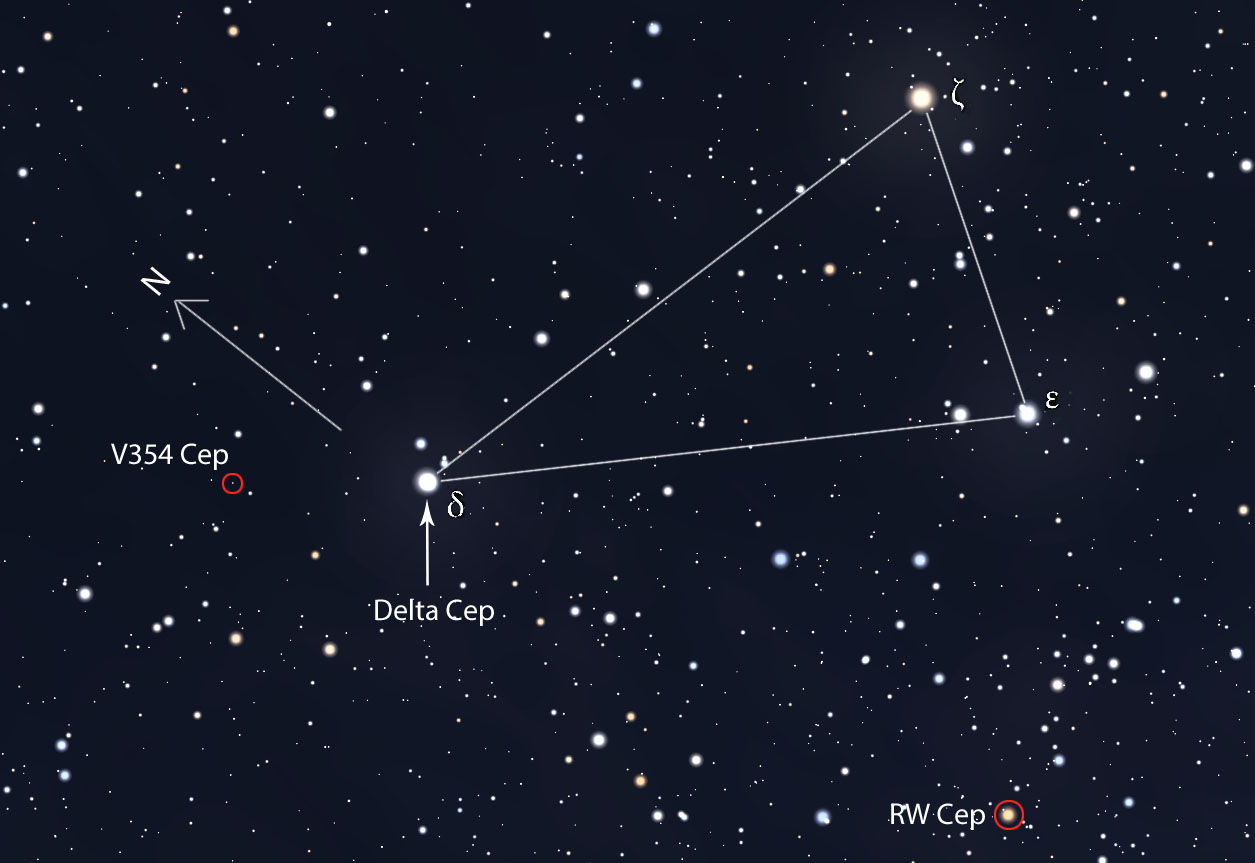
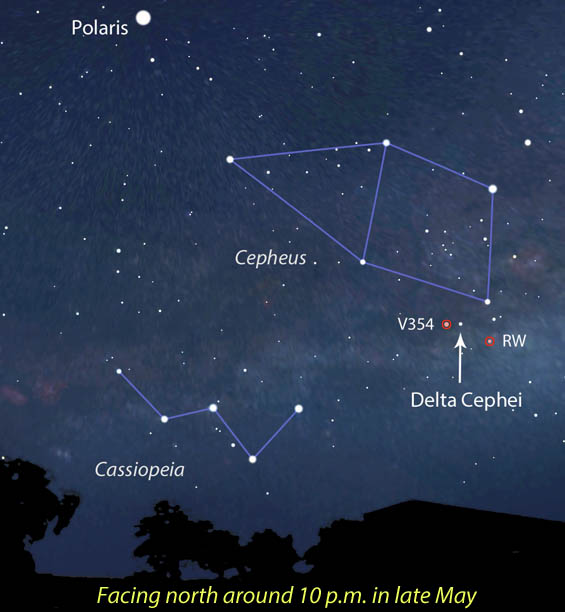
Supergiants RW Cep and V354 Cep are within a stone's throw of the famed variable, Delta Cephei, an easy naked-eye star. V354 lies 45′ northeast of Delta, while RW Cep is 2.5° south of the star. All three are circumpolar from many U.S., Canadia, and European locations.
Map: Bob King, Source: Stellarium
Lucky for us, both V354 Cep and RW Cep lie close to one of the most famous variables of all, Delta Cephei. Center Delta in your low power eyepiece and you're halfway there. RW shines around magnitude +6.5, so you can easily spot this fiery orange spark in binoculars; V354 will prove a little more challenging at its current magnitude of +11.7. You'll find AAVSO charts to which I've labeled the brighter stars to make a bit more intuitive hereand here.
Giant Variable Trio
Use this wide-view locator map to point you toward RW Cep and V354 Cep, both of which sit close to Delta Cephei. The view is from latitude 40° N.
Map: Bob King, Source: Stellarium
When describing stellar diameters, particularly the bloated red and yellow supergiants, determining a precise size is no easy task. Their atmospheres are so distended and vaporous, the diameters given in this article are best estimates and should be taken with a molecule of caution. Material lost through stellar winds creates shifting envelopes of gas and dust around each, making it tricky to say where star ends and winds begin.
Every one of these supergiants is a potential supernova candidate. Looking at them in the telescope, you can almost hear the sizzle of helium burning to carbon in their cores. As heat and pressure continue to forge new elements all the way up through iron, the stars will ultimately shut down, implode, and then explode as supernovae. Perhaps a tiny pulsar, a spinning neutron star the size of a city, will be left in the wake of the explosion. If so, in one fell swoop, the biggest stars will become the smallest.


https://linksredirect.com/?pub_id=11719CL10653&url=http%3A//www.airtel.in/