Wednesday, 30 November 2016

Laugh here - Don't hold me responsible if you don't get excitement

Don't hold me responsible if you don't get excitement


1. Q: Which sexual position produces the ugliest children?
A: Ask your mother.


2. A guy walks into a pub and sees a sign hanging over the bar which reads, "Cheese Sandwich: $1.50; Chicken Sandwich: $2.50; Hand Job: $10.00." Checking his wallet for the necessary payment, he walks up to the bar and beckons to one of the three exceptionally attractive blondes serving drinks to an eager-looking group of men. "Yes?" she enquires with a knowing smile, "Can I help you?" "I was wondering," whispers the man, "Are you the one who gives the hand jobs?" "Yes," she purrs, "I am." The man replies, "Well, go wash your hands, I want a cheese sandwich!"


3. A woman places an ad in the local newspaper. “Looking for a man with three qualifications: won’t beat me up, won’t run away from me, and is great in bed.” Two days later her doorbell rings. “Hi, I’m Tim. I have no arms so I won’t beat you, and no legs so I won't run away.” “What makes you think you are great in bed?” the woman retorts. Tim replies, “I rang the doorbell, didn’t I?”


4. There is a cucumber, a pickle, and a penis. They are complaining about their lives. The cucumber says, "My life sucks. I'm put in salads, and to top it off, they put ranch on me as well. My life sucks." The pickle says, "That's nothing compared to my life. I'm put in vinegar and stored away. Boy my life boring. I hate life." The penis says, "Why are you guys complaining? My life is so messed up that I feel like shooting myself. They put me in a plastic bag, put me in a cave, and make me do push-ups until I throw up."


5. It was Christmas Eve. A woman came home to her husband after a day of busy shopping. Later on that night when she was getting undressed for bed, he noticed a mark on the inside of her leg. "What is that?" he asked. She said, "I visited the tattoo parlor today. On the inside of one leg I had them tattoo 'Merry Christmas,' and on the inside of the other one they tattooed 'Happy New Year.'" Perplexed, he asked, "Why did you do that?" "Well," she replied, "now you can't complain that there's never anything to eat between Christmas and New Years!"


6. A typical macho man married a typical good looking lady, and after the wedding, he laid down the following rules. "I'll be home when I want, if I want, what time I want, and I don't expect any hassle from you. I expect a great dinner to be on the table, unless I tell you that I won't be home for dinner. I'll go hunting, fishing, boozing, and card playing when I want with my old buddies, and don't you give me a hard time about it. Those are my rules. Any comments?" His new bride said, "No, that's fine with me. Just understand that there will be sex here at seven o'clock every night, whether you're here or not."


7. There was an old couple laying in bed. The man turns and tells the woman, "If you want to have sex, pull on my dick once. If you don't want to have sex, pull on my dick one hundred times."


8. Three guys go to a ski lodge, and there aren't enough rooms, so they have to share a bed. In the middle of the night, the guy on the right wakes up and says, "I had this wild, vivid dream of getting a hand job!" The guy on the left wakes up, and unbelievably, he's had the same dream, too. Then the guy in the middle wakes up and says, "That's funny, I dreamed I was skiing!"


9. A trucker who has been out on the road for two months stops at a brothel outside Atlanta. He walks straight up to the Madam, drops down $500 and says, "I want your ugliest woman and a grilled cheese sandwich!" The Madam is astonished. "But sir, for that kind of money you could have one of my prettiest ladies and a three-course meal." The trucker replies, "Listen darlin’, I’m not horny – I’m just homesick."


10. Three brothers are traveling along a road, and their car dies. They all get out of the car, and start walking to a barn that's a little ways away. When they get their, the farmer comes out of the barn, and offers them a room for one night. He says to the first one, "You can sleep with the pigs," the second guy," you can sleep with the cows", and the third guy, "I like the cut of your jib. You can sleep with my 18 daughters." The next morning, he asks everyone how they slept. The first man said, "I slept like a pig." The second man said ,"I slept like a cow." The third guy said, "I slept like a rabbit. I jumped from hole, to hole, to hole."


11. A lawyer married a woman who had previously divorced 10 husbands. On their wedding night, she told her new husband, "Please be gentle, I'm still a virgin." "What?" said the puzzled groom. "How can that be if you've been married 10 times?" "Well, Husband #1 was a sales representative. He kept telling me how great it was going to be. Husband #2 was in software services. He was never really sure how it was supposed to function, but he said he'd look into it and get back to me. Husband #3 was from field services. He said everything checked out diagnostically, but he just couldn't get the system up. Husband #4 was in telemarketing. Even though he knew he had the order, he didn't know when he would be able to deliver. Husband #5 was an engineer. He understood the basic process, but wanted three years to research, implement, and design a new state-of-the-art method. Husband #6 was from finance and administration. He thought he knew how, but he wasn't sure whether it was his job or not. Husband #7 was in marketing. Although he had a nice product, he was never sure how to position it. Husband #8 was a psychologist. All he ever did was talk about it. Husband #9 was a gynecologist. All he did was look at it. Husband #10 was a stamp collector. All he ever did was... God! I miss him! But now that I've married you, I'm really excited!" "Good," said the new husband, "but, why?" "You're a lawyer. This time I know I'm going to get screwed!"


12. I was sitting on my own in a restaurant, when I saw a beautiful woman at another table. I sent her a bottle of the most expensive wine on the menu. She sent me a note, “I will not touch a drop of this wine unless you can assure me that you have seven inches in your pocket.” I wrote back, “Give me the wine. As gorgeous as you are, I'm not cutting off three inches for anyone.”

Astronomy - 10 Things You Didn't Know About the Moon

Astronomy - 10 Things You Didn't Know About the Moon


10 Things You Didn't Know About the Moon
As the full moon approaches, its growing brightness tends to capture our attention.
The full moon occurs when the moon is on the opposite side of Earth from the sun, so that its face is fully illuminated by the sun's light. [Photos: Our Changing Moon]
But any day of the month, the moon has some secrets up her sleeve. Here are 10 surprising and strange facts about the moon that may surprise you:
1) There's actually four kinds of lunar months
Our months correspond approximately to the length of time it takes our natural satellite to go through a full cycle of phases.  From excavated tally sticks, researchers have deduced that people from as early as the Paleolithic period counted days in relation to the moon's phases. But there are actually four different kinds of lunar months.  The durations listed here are averages.
1.     Anomalistic – the length of time it takes the moon to circle the Earth, measured from one perigee (the closest point in its orbit to Earth) to the next: 27 days, 13 hours, 18 minutes, 37.4 seconds.
2.     Nodical – the length of time it takes the moon to pass through one of its nodes (where it crosses the plane of the Earth's orbit) and return to it: 27 days, 5 hours, 5 minutes, 35.9 seconds.
3.     Sidereal – the length of time it takes the moon to circle the Earth, using the stars as a reference point: 27 days, 7 hours, 43 minutes, 11.5 seconds.
4.     Synodical – the length of time it takes the moon to circle the Earth, using the sun as the reference point (that is, the time lapse between two successive conjunctions with the sun – going from new moon to new moon): 29 days, 12 hours, 44 minutes, 2.7 seconds.  It is the synodic month that is the basis of many calendars today and is used to divide the year.
Supermoons can appear 30 percent brighter and up to 14 percent larger than typical full moons. <a href="http://www.space.com/11161-supermoon-full-moon-science-infographic.html">Learn what makes a big full moon a true 'supermoon' in this Space.com infographic</a>.
Supermoons can appear 30 percent brighter and up to 14 percent larger than typical full moons. Learn what makes a big full moon a true 'supermoon' in this Space.com infographic.
Credit: Karl Tate/SPACE.com
2) We see slightly more than half of the moon from Earth
Most reference books will note that because the moon rotates only once during each revolution about the Earth, we never see more than half of its total surface. The truth, however, is that we actually get to see more of it over the course of its elliptical orbit: 59 percent (almost three-fifths). ['Supermoon' Full Moons Explained]
The moon's rate of rotation is uniform but its rate of revolution is not, so we're able to see just around the edge of each limb from time to time.  Put another way, the two motions do not keep perfectly in step, even though they come out together at the end of the month. We call this effect libration of longitude.
So the moon "rocks" in the east and west direction, allowing us to see farther around in longitude at each edge than we otherwise could. The remaining 41 percent can never be seen from our vantage point; and if anyone were on that region of the moon, they would never see the Earth.
3) It would take hundreds of thousands of moons to equal the brightness of the sun
The full moon shines with a magnitude of -12.7, but the sun is 14 magnitudes brighter, at -26.7.  The ratio of brightness of the sun versus the moon amounts to a difference of 398,110 to 1.  So that's how many full moons you would need to equal the brightness of the sun.  But this all a moot point, because there is no way that you could fit that many full moons in the sky.
The sky is 360 degrees around (including the half we can't see, below the horizon), so there are over 41,200 square degrees in the sky. The moon measures only a half degree across, which gives it an area of only 0.2 square degrees. So you could fill up the entire sky, including the half that lies below our feet,  with 206,264 full moons — and still come up short by 191,836 in the effort to match the brightness of the sun.
4) The first- or last-quarter moon is not one half as bright as a full moon
If the moon's surface were like a perfectly smooth billiard ball, its surface brightness would be the same all over. In such a case, it would indeed appear half as bright.[Phases of the Moon Explained]
But the moon has a very rough topography. Especially near and along the day/night line (known as the terminator), the lunar landscape appears riddled with innumerable shadows cast by mountains, boulders and even tiny grains of lunar dust.  Also, the moon's face is splotched with dark regions.  The end result is that at first quarter, the moon appears only one eleventh as bright as when it's full. 
The moon is actually a little brighter at first quarter than at last quarter, since at that phase some parts of the moon reflect sunlight better than others.
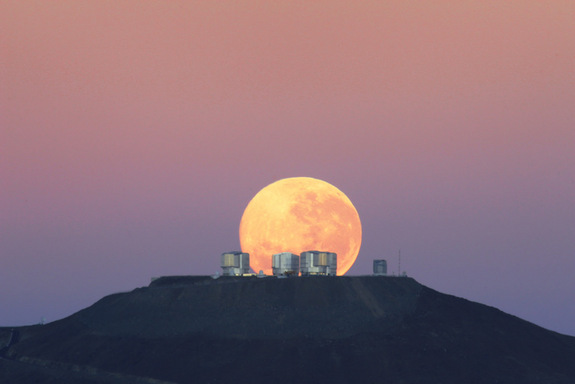
The dazzling full moon sets behind the Very Large Telescope in Chile's Atacama Desert in this photo released June 7, 2010 by the European Southern Observatory. The moon appears larger than normal due to an optical illusion of perspective. <a href=http://www.space.com/scienceastronomy/spectacular-moon-photo-over-chile-100609.html>Full Story</a>.
The dazzling full moon sets behind the Very Large Telescope in Chile's Atacama Desert in this photo released June 7, 2010 by the European Southern Observatory. The moon appears larger than normal due to an optical illusion of perspective. Full Story.
Credit: Gordon Gillet, ESO.
5) A 95-percent illuminated moon appears half as bright as a full moon
Believe it or not, the moon is half as bright as a full moon about 2.4 days before and after a full moon.  Even though about 95 percent of the moon is illuminated at this time, and to most casual observers it might still look like a "full" moon, its brightness is roughly 0.7 magnitudes less than at full phase, making it appear one-half as bright.
6) The Earth, seen from the moon, also goes through phases
However, they are opposite to the lunar phases that we see from the Earth. It's a full Earth when it's new moon for us; last-quarter Earth when we're seeing a first-quarter moon; a crescent Earth when we're seeing a gibbous moon, and when the Earth is at new phase we're seeing a full moon. 
From any spot on the moon (except on the far side, where you cannot see the Earth), the Earth would always be in the same place in the sky.
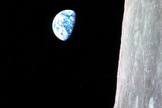
From the moon, our Earth appears nearly four times larger than a full moon appears to us, and – depending on the state of our atmosphere – shines anywhere from 45 to 100 times brighter than a full moon.  So when a full (or nearly full) Earth appears in the lunar sky, it illuminates the surrounding lunar landscape with a bluish-gray glow.  
From here on the Earth, we can see that glow when the moon appears to us as a crescent; sunlight illuminates but a sliver of the moon, while the rest of its outline is dimly visible by virtue of earthlight.  Leonardo da Vinci was the first to figure out what that eerie glow appearing on the moon really was.
7) Eclipses are reversed when viewing from the moon
Phases aren't the only things that are seen in reverse from the moon.  An eclipse of the moon for us is an eclipse of the sun from the moon.  In this case, the disk of the Earth appears to block out the sun. 
If it completely blocks the sun, a narrow ring of light surrounds the dark disk of the Earth; our atmosphere backlighted by the sun.  The ring appears to have a ruddy hue, since it's the combined light of all the sunrises and sunsets occurring at that particular moment.  That's why during a total lunar eclipse, the moon takes on a ruddy or coppery glow. 
When a total eclipse of the sun is taking place here on Earth, an observer on the moon can watch over the course of two or three hours as a small, distinct patch of darkness works its way slowly across the surface of the Earth.  It's the moon's dark shadow, called the umbra, that falls on the Earth, but unlike in a lunar eclipse, where the moon can be completely engulfed by the Earth's shadow, the moon's shadow is less than a couple of hundred miles wide when it touches the Earth, appearing only as a dark blotch.
8) There are rules for how the moon's craters are named
The lunar craters were formed by asteroids and comets that collided with the moon.  Roughly 300,000 craters wider than 1 km (0.6 miles) are thought to be on the moon's near side alone. 
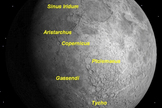
These are named for scholars, scientists, artists and explorers.  For example, Copernicus Crater is named for Nicolaus Copernicus, a Polish astronomer who realized in the 1500s that the planets move about the sun. Archimedes Crater is named for the Greek mathematician Archimedes, who made many mathematical discoveries in the third century B.C.
The custom of applying personal names to the lunar formations began in 1645 with Michael van Langren, an engineer in Brussels who named the moon's principal features after kings and great people on the Earth.  On his lunar map he named the largest lunar plain (now known as Oceanus Procellarum) after his patron, Phillip IV of Spain. 
But just six years later, Giovanni Battista Riccioli of Bologna completed his own great lunar map, which removed the names bestowed by Van Langren and instead derived names chiefly from those of famous astronomers — the basis of the system which continues to this day.  In 1939, the British Astronomical Association issued a catalog of officially named lunar formations, "Who's Who on the Moon," listing the names of all formations adopted by the International Astronomical Union.
Today the IAU continues to decide the names for craters on our moon, along with names for all astronomical objects.  The IAU organizes the naming of each particular celestial feature around a particular theme. 
The names of craters now tend to fall into two groups. Typically, moon craters have been named for deceased scientists, scholars, explorers, and artists who've become known for their contributions to their respective fields.  The craters around the Apollo crater and the Mare Moscoviense are to be named after deceased American astronauts and Russian cosmonauts.
The best time to observe the moon this month is over the next few nights.
Credit: Starry Night Software
9) The moon encompasses a huge temperature range
If you survey the Internet for temperature data on the moon, you're going to run into quite a bit of confusion. There's little consistency even within a given website in which temperature scale is quoted: Celsius, Fahrenheit, even Kelvin. 
We have opted to use the figures that are quoted by NASA on its Website: The temperature at the lunar equator ranges from an extremely low minus 280 degrees F (minus 173 degrees C) at night to a very high 260 degrees F (127 degrees C) in the daytime. In some deep craters near the moon's poles, the temperature is always near minus 400 degrees F (minus 240 degrees C).
During a lunar eclipse, as the moon moves into the Earth's shadow, the surface temperature can plunge about 500 degrees F (300 degrees C) in less than 90 minutes.  
10) The moon has its own time zone
It is possible to tell time on the moon.  In fact, back in 1970, Helbros Watches asked Kenneth L. Franklin, who for many years was the chief astronomer at New York's Hayden Planetarium, to design a watch for moon walkers that measures time in what he called "lunations," the period it takes the moon to rotate and revolve around the Earth; each lunation is exactly 29.530589 Earth days.
For the moon, Franklin developed a system he called "lunar mean solar time," or Lunar Time (LT).   He envisioned local lunar time zones similar to the standard time zones of Earth, but based on meridians that are 12-degrees wide (analogous to the 15-degree intervals on Earth).  "They will be named unambiguously as '36-degree East Zone time,' etc., although 'Copernican time,' 'West Tranquillity time' and others may be adopted as convenient."   A lunar hour was defined as a "lunour," and decilunours, centilunours and millilunours were also introduced.  
Interestingly, one moon watch was sent to the president of the United States at the time, Richard M. Nixon, who sent a thank you note to Franklin. The note and another moon watch were kept in a display case at the Hayden Planetarium for several years. 
Quite a few visitors would openly wonder why Nixon was presented with a wristwatch that could be used only on the moon.     
Forty years have come and gone without the watch becoming a big seller. 


Astronomy - Top 10 facts about galaxies

Astronomy - Top 10 facts about galaxies


THE superhero-packed film Guardians Of The Galaxy has been launched this week on Blu-ray, 3D Blu-ray, DVD and Digital formats.


Facts about galaxies, Facts about space, astronomy, Deep space facts, Milkyway Galaxy, Solar System, William Hartston, Planets,MOMENT/GETTY
Our Sun completes an orbit of the Milky way once every 225 million years
1. There are close to 200 billion galaxies in the observable universe, each comprising billions of stars orbiting the galaxy’s centre of mass. 
2. These range from dwarf galaxies with as few as ten million stars to giant galaxies with a 100 trillion stars. 
3. Our Sun completes an orbit of the Milky Way galaxy about once every 225million years.
The Milky Way is a barred spiral galaxy, shaped like a spiral with a bar across its centre
William Hartston
4. On this orbit, it travels at a speed of about 220km (140 miles) per second. 
5. The Milky Way is a barred spiral galaxy, shaped like a spiral with a bar across its centre. 
6. The Milky Way’s nearest neighbour is the Andromeda Galaxy which is about 2.5 million light years (that’s 15 million trillion miles) away. 
7. In about 4.5 billion years’ time, the Milky Way is expected to collide with Andromeda.
8. The word galaxy comes from an ancient Greek word for milky (as in lactic). They called the Milky Way a milky circle. 
9. In 1940, a cartoon called The Milky Way became the first non-Disney animation to win an Oscar. 
10. Edwin Hubble, in the 1920s, was first to confirm that the Milky Way was just one of many galaxies.


Ancients - Remains of a 7,000-Year-Old Lost City Discovered in Egypt

Remains of a 7,000-Year-Old Lost City Discovered in Egypt

Ancients - Remains of a 7,000-Year-Old Lost City Discovered in Egypt


Archaeologists working in Egypt have made an unprecedented find of a previously unknown city containing huts, iron and stone tools, pottery, and even a small cemetery in the southern province of Sohag.
The Guardian reports that the archaeologists unearthed their fantastic find just 400 meters (1312.34 ft.) from the Temple of Seti I, across the Nile from Luxor. It is believed that the forgotten city once housed high-ranking officials and grave builders and dates to about 5316 BC.
A section of the newly-discovered site with some artifacts found within it.
A section of the newly-discovered site with some artifacts found within it. (Ministry of Antiquities)
So far, the archaeologists have found 15 large mastabas (mudbrick tombs). However, this may be a question of quality over quantity, as Antiquities Minister Mahmoud Afifi said in a statement:
“The size of the graves discovered in the cemetery is larger in some instances than royal graves in Abydos dating back to the first dynasty, which proves the importance of the people buried there and their high social standing during this early era of ancient Egyptian history.”
One of the excavated graves.
One of the excavated graves. (Ministry of Antiquities)
Egypt Independent says the excavations are underway by an Egyptian archaeological mission belonging to the Ministry of Antiquities. The group consists of “young Egyptian archaeologists specialized in excavations, pottery, paintings and human bones.”
The antiquities ministry hopes that the discovery will provide new information on Abydos, one of ancient Egypt’s oldest (3,100 – 332 BC) and most important archaeological sites.
The Abydos boats are some of the fascinating artifacts that have been found there during previous excavations. The large size and features of the boats suggest that they could have been used for sailing, however the funerary links tend to dominate over that idea.
Some of the Abydos boats in their brick-built graves.
Some of the Abydos boats in their brick-built graves. (Maritimehistorypodcast.com)
Yet, one of the most memorable features of Abydos is the temple of Seti I. The iconic structure was built mainly of limestone, though some sections were made with sandstone. Ancient Origins writer Dwhty provides more information on the temple’s characteristics:
“Seti’s temple was dedicated to Osiris, and consisted of a pylon, two open courts, two hypostyle halls, seven shrines, each to an important Egyptian deity (Horus, Isis, Osiris, Amun-Ra, Ra-Horakhty and Ptah) and one to Seti himself, a chapel dedicated to the different forms of the god Osiris, and several chambers to the south. In addition to the main temple, there was also an Osireion at the back of it. Various additions to the temple were made by later pharaohs, including those from the Late, Ptolemaic and Roman periods.”
Entrance to the Temple of Seti I.
Entrance to the Temple of Seti I. (Hannah Pethen /CC BY SA 2.0)
This temple in Abydos is among the most famous in the country and some scholars claimit is the “most impressive religious structure still standing in Egypt.” Even though Seti I began the work on the temple, it was not completed until his son, Ramesses II, reigned. Despite Seti bringing order back to Egypt following the disruption caused by Akhenaten’s religious reforms, his story is largely overshadowed by his more famous son.
Regarding the pharaoh and his kin, within Seti I’s temple, one can find the well-known Abydos King List. This is a list of 76 Egyptian kings which has proven itself a useful tool in deciphering ancient Egyptian history – even if it is not complete.
Drawing of cartouches on the Abydos King List.
Drawing of cartouches on the Abydos King List. (PLstrom/CC BY SA 3.0)
But there may be even more intriguing information tucked away in the Temple of Seti I. John Black described one of the more controversial finds made within Seti’s temple for Ancient Origins. He wrote:
“On one of the ceilings of the temple, strange hieroglyphs were found that sparked a debate between Egyptologists. The carvings appear to depict modern vehicles resembling a helicopter, a submarine, and airplanes. At first the images circulating were thought to be fakes, but were later filmed and verified as valid images. Yet, even if these images clearly appear to resemble twentieth century machines, Egyptologists have tried to offer a rational explanation.”
Hieroglyphs showing seemingly modern aircraft and vehicles in the Temple of Seti I in Abydos.
Hieroglyphs showing seemingly modern aircraft and vehicles in the Temple of Seti I in Abydos. (Public Domain)
Though debate continues about that provocative subject, the most recent find hints that there are still many secrets waiting to be exposed around the ancient Egyptian site of Abydos.


Tuesday, 29 November 2016

Horoscope for Wednesday 30th November 2016

Horoscope for Wednesday 30th November 2016


Are you curious to know what today has in store for you? Jessica Adams' free daily horoscope will help you to plan your Wednesday.

Aries

Aries

March 21 - April 19
I am sure you are speculating about travel, foreigners, study, teaching, websites, books or regional connections. Be realistic. You do not have all the facts and you need to ask questions over the next week or so, and accept what you are told or shown. It's life.

TAURUS Apr 20 - May 20

Taurus

April 20 - May 20
Wishful thinking and hopeful, vague daydreaming do not have any place in your financial, charity, property or business life now. That will not stop you, of course, but you may be better off being a total realist about what might just be happening - or going to happen.

GEMINI May 21 - Jun 22

Gemini

May 21 - June 20
You have some sketchy ideas about where it might go with your former, current or potential partner. How it may work out with your rival, enemy or opponent. Abandon sketchy and try gritty. Be a little hard-nosed about this and ask pertinent questions, shortly.

CANCER Jun 21 - Jul 22

Cancer

June 21 - July 22
Saturn is TINA - There Is No Alternative. It is better to live with Tina and deal with her, right now. Especially with work, study, unpaid work or parenting. This is also very true of your physical condition and state. Take Tina as she comes. Deal. And find out facts.

LEO Jul 23 - Aug 22

Leo

July 23 - August 22
Courtship, babies, children and Millennials are all part of Saturn's domain now. So try to ditch the lovely stories you tell yourself or the facts you are not looking at. It is far better to be practical about what's probable, and likely - and then check details within days.

VIRGO Aug 23 - Sep 22

Virgo

August 23 - September 22
People will do, what they are going to do. Organisations too. Likewise, houses, apartments, councils or governments are what they are! Nobody said you had to be a grey-faced pessimist about this stuff, but it would help to be sensible and look at the likelihoods.

LIBRA Sep 23 - Oct 22

Libra

September 23 - October 22
Saturn is about to show you what's what, who's where and what the deal is. Your life on the internet, on the telephone or in face-to-face communication is the story here. Rather than go into the next couple of weeks in denial or avoidance, just expect the expected.

Scorpio

Scorpio

October 23 - November 21
We are entering Saturn Season. Money, house, business, company, apartment, possessions, charity. That kind of thing. Be slightly pessimistic about this. Be reasonable and see what statistics and human nature is likely to present - not what an ostrich only sees.

SAGITTARIUS Nov 22 - Dec 21

Sagittarius

November 22 - December 21
Saturn in Sagittarius will reveal what is true, known and real about your image, title, appearance, reputation or name this Christmas. Not what you fancy or conjecture. We wish it was otherwise, but also - you have nothing to lose by anticipating what's realistic.

Capricorn

Capricorn

December 22 - January 19
A shrewd outsider would give you what she/he anticipates with a matter which is secret, or carried out behind the scenes. Be that person, for yourself. Don't just walk into this with your imagination replacing reality. Find out what's actually going on, then deal.

1circle-aquarius-150x150

Aquarius

January 20 - February 18
People will do, what they are going to do, this year. You know the personality and circumstances of your friends, or the group, well enough to know that you'll get - exactly what you get! Lovely fantasies are best binned. Be open minded about what's most likely.

1circle-pisces-150x150

Pisces

February 19 - March 20
Your career, unpaid work, study or parenting is parked firmly in the 'Wake up and smell the manure' zone this December. Manure is good. You can work with it. It grows things. Right now, you need to ask the questions that show you what you have to work with!


Make my trip:
U can book flights here:

https://linksredirect.com/?pub_id=11719CL10653&source=linkkit&url=http%3A//www.makemytrip.com/flights/