Up, Up, and Away with Comet 252P
With the Moon finally put to bed and Comet 252P still bright, there's no better time than now to see it. Nearby Mars and Saturn only sweeten the deal.

Comet 252P/LINEAR displays a faint, 30′ long ion tail pointing west in this photo taken through a 10-inch reflector on April 3, 2016.
Michael Jaeger
Michael Jaeger
A wonderful thing happened this week. The morning Moon exited the sky, and Comet 252P/LINEAR finally came into its own. Naked-eye sightings began to trickle in as early as April 1–2, while the moon was still a thick crescent. Most magnitude estimates at the time put the comet around +5.5.
On April 1st, I suspected the 252P with the naked eye using averted vision but saw it plainly in 10×50 binoculars from a moderately dark site, even in moonlight. The coma was impressive — a soft, smoky patch almost 1° across with a slightly brighter center. No tail was visible.
Comet observers rate how the brightness of a comet increases towards its center — its Degree of Condensation (DC) — on a scale from 0 to 9, where 0 indicates a diffuse coma of uniform brightness and 9 a stellar coma. DC increases as the coma shrinks and become more sharply defined. Unlike many comets that possess a bright nuclear region, 252P coma has been consistently rating a DC of 2: diffuse with a slight but definite brightening toward the center.
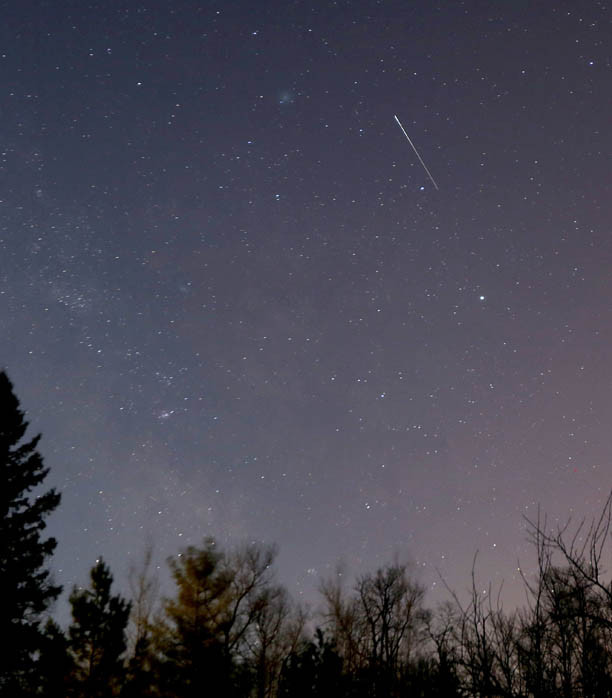
This wide-angle photo of 252P/LINEAR was made at the start of dawn on April 1st and gives a good impression of the comet through binoculars. The comet is the fuzzy spot to upper left of the streak made by a tumbling satellite that happened to pass through the field during the 15-second time exposure.
Bob King
Bob King
Australian amateur Chris Wyatt and others report that a Swan Band comet filter strongly enhances the comet's contrast and brightness. The filter isolates the green light of diatomic carbon emissions in gaseous comets like 252P, making them stand out, the same way a nebular filter enhances an emission nebula. I've often used it at the telescope, but Wyatt held it up to his eye to get a better naked-eye view.
As of April 5th, the comet hovers at the naked-eye limit of magnitude +6. Yes, it's fading, but not so fast that you can't still get a wonderful view in either binoculars or telescope. As seen in a 10-inch or larger scope, 252P fills most of the field of view and reveals a very faint, not-quite-stellar nucleus. Since it's still moving along at a fairly good clip — still more than 1° a day or about 3′ per hour — you can detect its motion in a half hour or less through a scope.
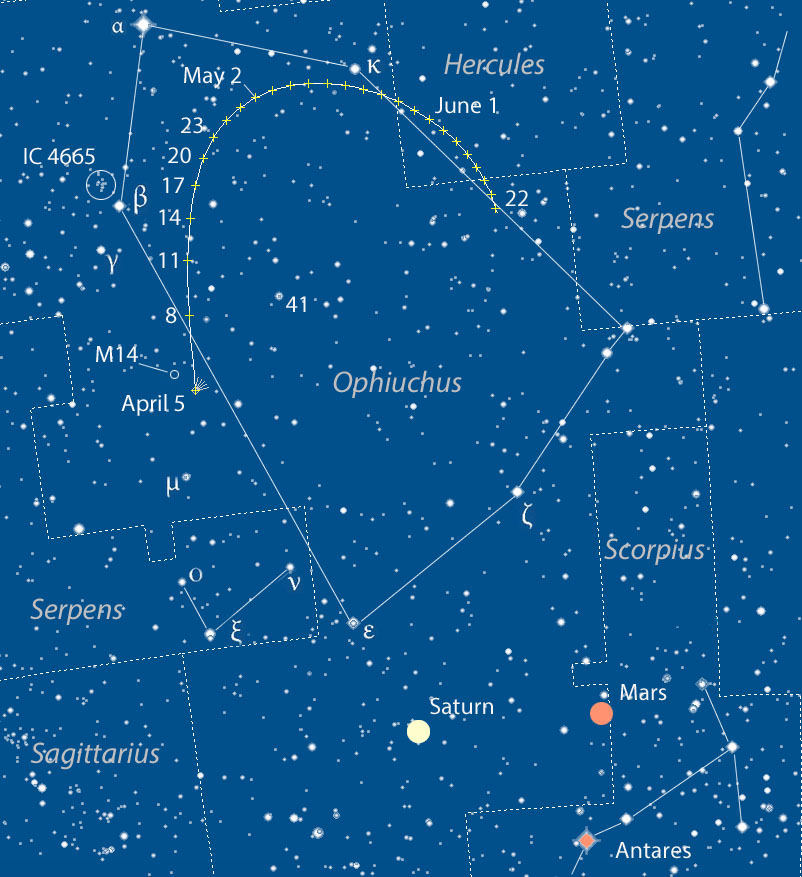
Use this map to help you track Comet 252P/LINEAR through June. The comet's position is marked every three days at 5 a.m. local DST starting April 5th. Stars are labeled with their Greek (Bayer) letters and Flamsteed numbers and plotted to magnitude +8.0. Saturn's and Mars’s positions are for early April. All the Greek-lettered stars are bright enough to see with the naked eye.
Chris Marriott’s SkyMap
Chris Marriott’s SkyMap
Plus it's all gravy from here on out: no Moon to madden, and the comet climbs steadily northward through the constellation Ophiuchus. Only recently has 252P begun to show a tail. Photos taken in the past few days show a stub of an ion tail issuing from the nuclear region. Why no tail until now? It's probably a matter of spatial perspective. Earlier, we were looking down the tail. Now that the comet has passed Earth, we're seeing it more from the side. Try playing around with this interactive 3D orbital diagram of 252P/LINEAR created by Dominic Ford and see what you think.
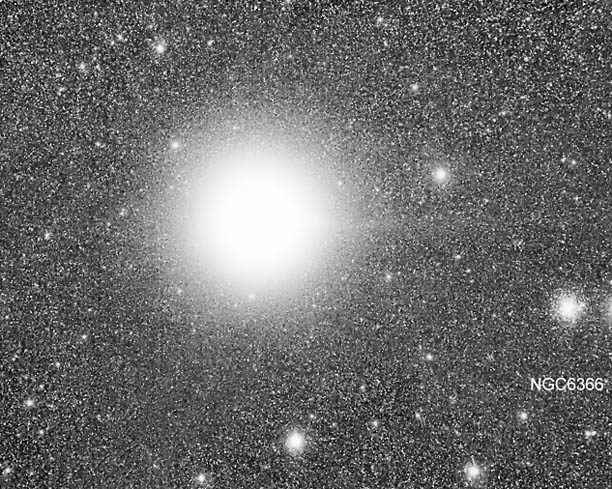
A deep exposure made on April 5th shows the tail more clearly. The coma measures 80′ across, the ion tail, 100′.
Michael Jaeger
Michael Jaeger
252P is best viewed just before the start of dawn when it stands well up in the southern sky not far from the meridian. Use the accompanying map to help guide you to its lair. As payback for the trouble of getting up and losing sleep, two other bonbons await — Mars and Saturn. Time with Saturn is never wasted. Is there a more unique object anywhere in the celestial sphere? The rings are within a fraction of a degree of fully open, their north face tilted in our direction. What more of an invitation do you need?
Then there's Mars. I examined it right after the comet and was frankly shocked at how big it's grown. (Guess I need to get out more.) Over the coming week, the Red Planet swells in the eyepiece from 12.6″ to 13.5″ as it hurries toward its May 22nd opposition.

Don't pass up the chance to view Mars and Saturn after looking at the comet. Both planets are located in the same neighborhood in the constellation Ophiuchus, not far from Antares in Scorpius.
Bob King
Bob King
For western hemisphere observers, the feature-rich half of Mars has been slowly coming around. During the next few mornings, watch for the dark thumb of Mare Acidalium in the northern hemisphere and the chicken drumstick-shaped Sinus Meridiani/Sinus Sabeus closer to the equator. A week from now (around April 14–20), the planet's most prominent feature, Syrtis Major, an enormous ancient shield volcano, will dominate the center of the disk. You might notice a faux polar cap to the south of Syrtis. What you're really seeing are bright clouds over the huge impact basin Hellas.
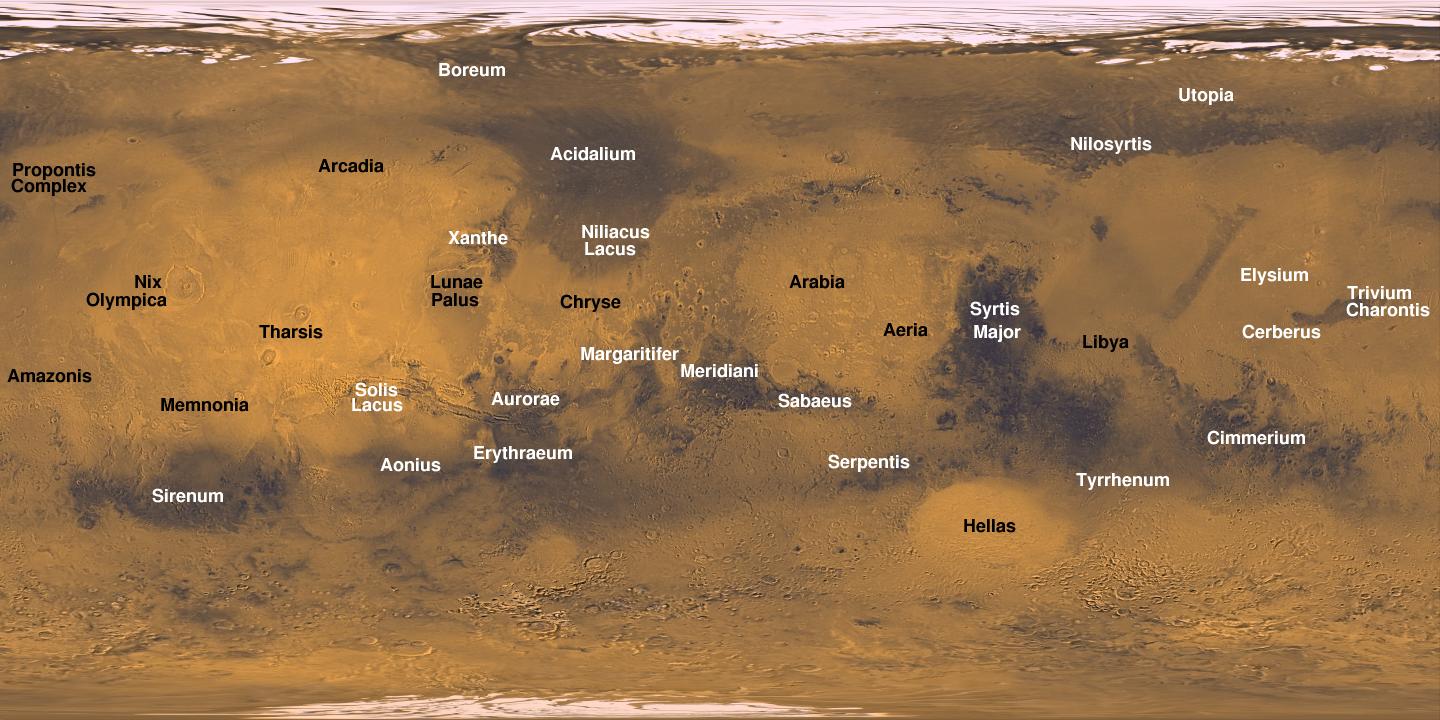
These bright and dark albedo features on Mars, which bear traditional names, are what observers are most likely to see with a telescope. North is up; longitude is labeled along the bottom. Click on the image to see a larger map.
If you want to know which side on Mars faces your way at any hour, visit and bookmark Sky & Telescope's Mars Profiler. Set your alarm and enjoy a fantastic pre-dawn sky!

No comments:
Post a Comment